Ornate Layers: Using Mandala Patern Layered Mangekyou Flowers
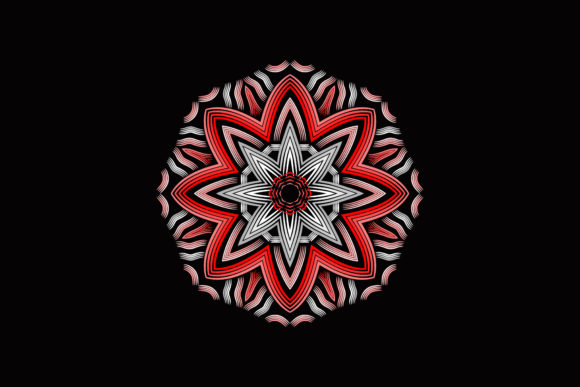
There is a specific type of visual complexity that immediately commands attention—something intricate, symmetrical, and deeply rooted in a sense of movement. When you first encounter the Mandala Patern Layered Mangekyou Flowers design asset, you are met with exactly that: a hypnotic blend of floral geometry and layered depth. For designers and entrepreneurs working in the creative space, finding assets that balance high aesthetic appeal with technical versatility is often the biggest hurdle. This particular vector set solves that problem by offering a design that functions as both a standalone centerpiece and a versatile background element. It is not merely a static image; it is a comprehensive tool designed for precision printing, laser cutting, and high-resolution digital application, making it an essential addition to any serious design library.
The Intersection of Tradition and Modern Design
The visual language of mandalas has been used for centuries to represent the universe, but in modern design, we often use them to create a sense of harmony and focus. The "Mangekyou" aspect of this design introduces a kaleidoscope-like complexity, creating layers that seem to shift as the viewer looks closer. This makes the Mandala Patern Layered Mangekyou Flowers particularly effective for projects that require a premium aesthetic without relying on standard stock photography. Whether you are a small business owner looking to establish a distinct brand identity or a crafter looking for the next unique project, the layered nature of this file allows for incredible adaptability.
From a technical standpoint, the value lies in the file format variety. The package includes JPEG, AI, and EPS files. If you are a professional working in Adobe Illustrator, the AI and EPS formats allow you to deconstruct the layers, change colors to match specific brand palettes, and scale the design infinitely without losing quality. This is crucial for logo design and large-format printing. Conversely, the JPEG format provides a high-quality solution for immediate use in social media management software or quick mockups. This versatility ensures that the asset works for you, not the other way around.
Practical Applications for Digital and Physical Products
Understanding how to deploy this asset effectively is key to maximizing your return on investment. The Mandala Patern Layered Mangekyou Flowers is not limited to one niche; its utility spans across various industries. For those in the wedding planning or event design business, this pattern is a goldmine. Imagine using the vector file to create intricate laser-cut invitations or table centerpieces. The symmetry of the mandala makes it perfect for circular die-cuts, doilies, or stencils for henna paintings.
In the digital realm, the applications are just as broad:
- Social Media Graphics: Use a desaturated version of the pattern as a background for Instagram quotes or Pinterest pins to add texture without overwhelming the text.
- Website Design: A subtle, low-opacity version can serve as a sophisticated background for a landing page, adding depth to the user experience.
- Packaging Design: For artisanal products like soaps, candles, or teas, this pattern communicates care, detail, and premium quality immediately.
- Merchandise: The complexity of the Mangekyou style translates beautifully onto physical goods like t-shirts, tote bags, or mugs.
The key is to view the design not just as a picture, but as a texture. Because it is a vector, you can manipulate the stroke weights or fill colors to match the mood of your project—bright and vibrant for a festival poster, or monochromatic and metallic for a luxury brand presentation.
Integrating Complex Patterns into Brand Identity
One of the challenges of using highly detailed assets like the Mandala Patern Layered Mangekyou Flowers is ensuring they integrate seamlessly with your typography and other design elements. A pattern this detailed has a strong "voice," so it needs to be paired with typefaces that can hold their own without creating visual clutter.
If you are building a logo or a header, consider pairing this mandala with a clean, sans serif font. The geometric simplicity of sans serif type creates a necessary contrast against the floral complexity of the mandala. For example, a bold, modern sans serif can anchor the design, making the logo feel professional and grounded. Conversely, if you are aiming for a more romantic or bohemian aesthetic, a flowing script font can intertwine with the floral elements, provided the font is legible at the intended size.
For editorial design or packaging, readability is paramount. If you use the mandala as a background element, ensure there is sufficient contrast between the pattern and the foreground text. You might need to apply a blur effect or a color overlay to the mandala layer so that your modern typography remains the focal point. The goal is to use the pattern to evoke a feeling—mystery, elegance, or creativity—while the text delivers the information.
Technical Precision for Crafters and Makers
For the hobbyist or the professional crafter, the inclusion of vector files is a game-changer. Raster images (like JPEGs) are made of pixels and become jagged when enlarged. Vectors, however, are mathematical paths. This means you can take the Mandala Patern Layered Mangekyou Flowers file and load it directly into a cutting machine (like a Cricut or Silhouette) or a laser cutter.
Imagine creating a wooden sign for a home décor project. With the EPS or AI file, you can tell the laser cutter to etch the intricate floral details onto the wood surface. The precision of the vector lines ensures that the cuts are clean and the symmetry is perfect—something that would be impossible to achieve by hand. Similarly, for textile printing, the vector format ensures that the colors remain sharp and the lines defined, whether you are printing on a small silk scarf or a large tablecloth.
This level of precision elevates your work from "homemade" to "professional." It allows you to offer products in your small business that look store-bought in terms of quality, giving you a competitive edge in the marketplace.
Strategic Use of Visual Complexity
When incorporating a design as detailed as the Mandala Patern Layered Mangekyou Flowers, strategic restraint is often required. While the pattern is beautiful, using it at full intensity on every surface can lead to visual fatigue for your audience. A smart approach is to use the full pattern for hero images or focal points, such as the front of a wedding invitation or the center of a poster. Then, use cropped or zoomed-in sections of the pattern for secondary elements, like the back of a business card or a footer graphic on a website.
This creates a cohesive visual system. It tells a story through repetition and variation. By using the same asset in different ways, you build brand recognition and a sense of intentionality in your design work. It shows that you have considered every detail of the user's experience, whether they are browsing your website or holding a physical product.
Ultimately, assets like this are about expanding your creative vocabulary. They provide you with the raw material to solve visual problems and communicate complex ideas—like luxury, spirituality, or intricate craftsmanship—without saying a word. Whether you are a graphic designer working on a client project or a content creator